How We Automated Vehicle Repair Documentation for a Fleet Operator — Cutting Processing Time from 3 Hours to 3 Minutes
🔍 The Problem
For companies managing a fleet of work vehicles, maintenance documentation is a legal and financial necessity — but the process behind it is often painfully manual.
Our client's workflow looked like this: a procurement team would export parts lists from their ERP into Excel. An admin would then open each row, check whether the total cost exceeded ¥3,000 or the item count exceeded four units, manually split the entries if needed, copy everything into a Word template, fill in each table cell by hand, and finally compile all individual documents into a single submission file.
With ten to twenty vehicles per cycle, this consumed two to three staff-hours every month. Worse, the error rate hovered around 15% — missed splits, wrong totals, or mismatched license plates — leading to repeated rejections from the finance department and rework cycles that nobody had time for.
The root cause was not a lack of effort. It was a workflow that was never designed to scale.
⚙️ Our Solution
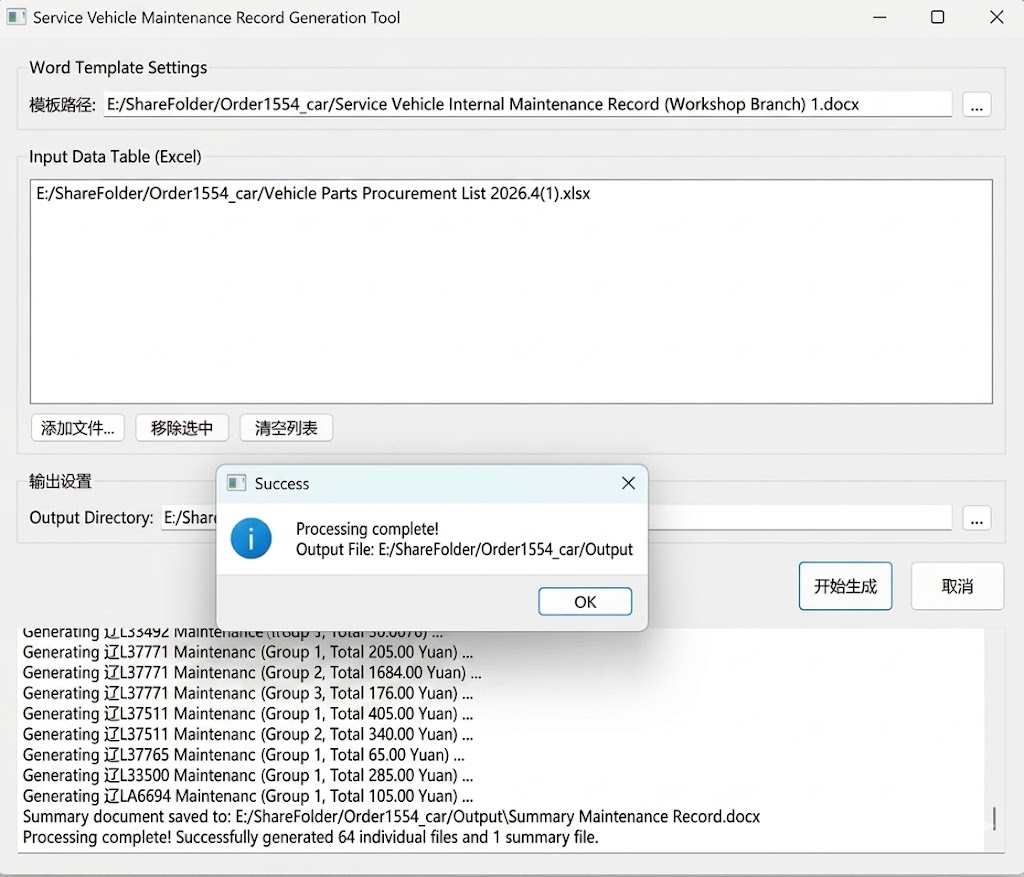
We designed and delivered a lightweight desktop application built with Python and PyQt6 — no server, no browser, no IT infrastructure required. The tool runs directly on the user's Windows machine as a standalone executable.
The workflow became:
- Drop one or more Excel procurement files into the interface.
- Click Generate.
- Collect the output folder.
Under the hood, the application uses pandas to ingest and clean the Excel data, forward-filling merged cells and grouping records by license plate number. A rule engine then splits each vehicle's parts list into compliant batches — each batch capped at ¥3,000 in taxed value and four line items. For every batch, python-docx populates a standardized Word template, filling each table cell with the correct part name, quantity, unit price, and computed total. Finally, docxcompose merges all individual documents into a single consolidated submission file, ready for finance review.
The entire application was packaged with PyInstaller into a single .exe file, requiring zero Python knowledge or installation on the client's end.
📈 The Impact
The results were immediate and measurable.
Before the tool, processing a full monthly cycle for 20 vehicles required approximately 3 hours of manual work across two staff members, with a ~15% error rate triggering frequent rework.
After deployment, the same cycle completes in under 3 minutes with a single click. The rule-based splitting logic eliminates human judgment errors entirely, and the templated output ensures every document meets compliance formatting requirements on the first submission.
The client estimated a recovery of over 30 staff-hours per quarter — time now redirected to higher-value operational tasks.
🤝 Work With Us
This project is one example of a pattern we solve regularly: structured data trapped in spreadsheets that needs to flow into formatted documents at scale. Whether your team is generating contracts, inspection reports, invoices, or compliance records, the underlying automation logic is often simpler than it looks.
We work with small and mid-sized businesses across industries, delivering focused automation tools that fit directly into existing workflows — no platform migration, no subscription fees, no steep learning curve.
Based in Wuhan, China, we serve clients remotely across Asia, Europe, and North America.
CTA:
If your team is still copy-pasting data into Word documents, let's talk — describe your workflow and we'll tell you exactly what's possible.
